Elder Futhark Runes: A Beginner’s Guide to the 24 Rune Meanings
Runes are letters. Before they became symbols on jewellery, cards and stones, they were an alphabet used to write early Germanic languages: carved into wood, bone, metal and stone. The oldest form of that alphabet is called the Elder Futhark, and it has 24 characters.
Each rune also had a name, and each name was a word: cattle, sun, ice, gift. Those words are where most modern rune meanings come from. This guide walks through all 24, with the reconstructed name, what the word meant and how each rune is commonly read today. We present runes as symbols and tradition, not as predictions or powers.
A short history
- When. The Elder Futhark was in use from roughly the 2nd to the 8th century CE, mostly in Scandinavia and other Germanic-speaking regions.
- The name. “Futhark” comes from the sounds of the first six runes: F, U, Th, A, R, K, much as “alphabet” comes from alpha and beta.
- Three groups of eight. The 24 runes are traditionally arranged in three rows of eight, often called ættir (singular ætt), an Old Norse word for a family or clan.
- The earliest full list. The Kylver Stone, found on the Swedish island of Gotland and dated to around 400 CE, carries one of the earliest known inscriptions of the complete sequence.
- What came after. Around the 8th century, the Elder Futhark gave way in Scandinavia to the shorter, 16-rune Younger Futhark, while Anglo-Saxon England developed its own longer rune row.
Where the meanings come from
No one wrote down a dictionary of the Elder Futhark. The rune names we use are scholarly reconstructions in Proto-Germanic, and much of what we know about their meanings comes from three medieval rune poems, in Old English, Old Norwegian and Old Icelandic, written centuries later about later rune rows. Some names are well attested; others, such as Perthro, remain uncertain. It is worth holding modern interpretations lightly.
What runes are, and are not
Using runes for fortune-telling, as many books describe today, is largely a modern practice. We do not use them to predict anything. At Lumina Flora, a rune is a symbol you choose to keep near, the way you might choose a word to write on a strip of paper.
The 24 rune meanings
The first ætt
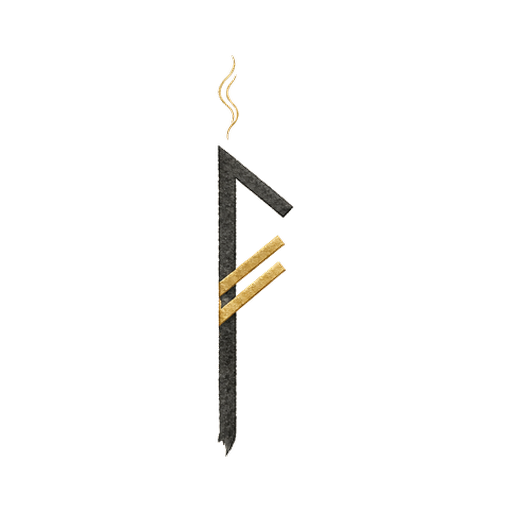
- Fehu (ᚠ) — cattle, wealth. In a herding culture, livestock was wealth. Read today as abundance, earned and shared.
- Uruz (ᚢ) — aurochs, the wild ox. Read as strength and endurance.
- Thurisaz (ᚦ) — giant or thorn. Read as a force to be respected, or a boundary.
- Ansuz (ᚨ) — a god, linked to the Æsir. Read as breath, speech and insight.
- Raidho (ᚱ) — ride, journey. Read as movement and the road ahead.
- Kenaz (ᚲ) — usually torch. Read as light, craft and a spark of will.
- Gebo (ᚷ) — gift. Read as exchange, generosity and partnership.
- Wunjo (ᚹ) — joy. Read as contentment and belonging.
The second ætt
- Hagalaz (ᚺ) — hail. Read as disruption that clears the way.
- Naudiz (ᚾ) — need. Read as constraint, patience and what is necessary.
- Isa (ᛁ) — ice. Read as stillness and a pause that holds.
- Jera (ᛃ) — year, harvest. Read as patience and things in their season.
- Eihwaz (ᛇ) — yew. Read as endurance and long change.
- Perthro (ᛈ) — meaning uncertain; often linked to a lot-cup or a game of chance. Read as the unknown.
- Algiz (ᛉ) — usually reconstructed as elk. Commonly read today as protection.
- Sowilo (ᛊ) — sun. Read as clarity, warmth and success.
The third ætt
- Tiwaz (ᛏ) — the god Týr. Read as justice and steadfastness.
- Berkano (ᛒ) — birch. Read as growth and renewal.
- Ehwaz (ᛖ) — horse. Read as trust and partnership in motion.
- Mannaz (ᛗ) — man, humankind. Read as the self among others.
- Laguz (ᛚ) — water, lake. Read as flow and intuition.
- Ingwaz (ᛜ) — the god Ing. Read as gestation and potential.
- Dagaz (ᛞ) — day. Read as dawn and a new beginning.
- Othala (ᛟ) — inheritance, ancestral home. Read as heritage and belonging.
In some sources, Dagaz and Othala appear in the opposite order.
The rune I come back to most is Jera: things in their season.
How to use rune meanings today
As a word to keep
Choose a rune whose meaning matches the sentence you are ready to write. Jera for a season of patience, Berkano for a new start, Gebo for a friendship.
As a symbol to wear
Several pieces in our Ritual Jewelry collection carry a rune, such as Laguz, Berkano or Gebo, chosen for what the word means. They are reminders, not charms.
Alongside an intention
Our Intentions page groups our kits by the sentence you might write: abundance, love or protection. A rune can sit beside that sentence as a single-character summary of it.
Frequently asked questions
How many runes are in the Elder Futhark?
Twenty-four, traditionally arranged in three groups of eight.
Are rune meanings historically accurate?
Partly. The names are scholarly reconstructions, and the meanings rely on medieval rune poems written much later. Modern readings build on that tradition with new interpretation.
Can runes predict the future?
We do not present them that way. Rune divination as practised today is largely a modern development. We treat runes as symbols you choose, not forecasts.
What is the difference between Elder and Younger Futhark?
The Elder Futhark has 24 runes and is the older form. The Younger Futhark, used in Scandinavia from around the 8th century, has 16.
Begin with one rune
You do not need to learn all 24 at once. Read the list, notice which word you keep returning to, and let that be the one you carry for a while.